.png)
INTRAPRENEUR INNOVATION
PROGRAM
Design Sprint
Service Design
.png)
Leadership
Payment solutions company | Financial sector
Structuring and conducting an Innovation Program inside a Brazilian payment company to generate a pool of innovative solutions. The program was an internal competition for employees to work collaborative on out of the box ideas to improve customer experience and bring financial positive impact to the company. The winer solution was implemented by the company and the responsible employee group rewarded.
”How can we create an intrapreneur innovation program based on the Design approach inside one of the biggest payment companies in Brazil?”
Also, part of the project scope included to educate the employees in the Design Thinking methodology along their involvement in the innovation program. What led us to facilitate a series of educational Design Thinking workshops before the Design Sprint phase to share about the design pillars of empathy, collaboration and experimentation. A “Service Design Thinking Toolkit” was also developed and adapted to the company's way of working by our team with principles, tools and best practices to guide them along the program.
There were two key challenges: engaging employees on agile methods and generating innovative ideas for the company to invest. With that in mind, the project's briefing was to create an Intrapreneur Innovation Program from scratch, with a test & learn mindset, fast-paced timeline and collaborative format. Based on that, the methodology chosen to structure the program was the Design Sprint.
Approach

Plan
● Planning the whole innovation program structure, schedule and scope
● Preparing the educational Design Thinking workshops content and practical activities
● Planning the Design Sprint structure of activities, content and materials
● Conducting the educational Design Thinking workshops with participant groups
● Guiding the recruitment of real external users for each one of the 7 Design Sprint themes/challenges
Learn & prepare
Design (Sprint!)
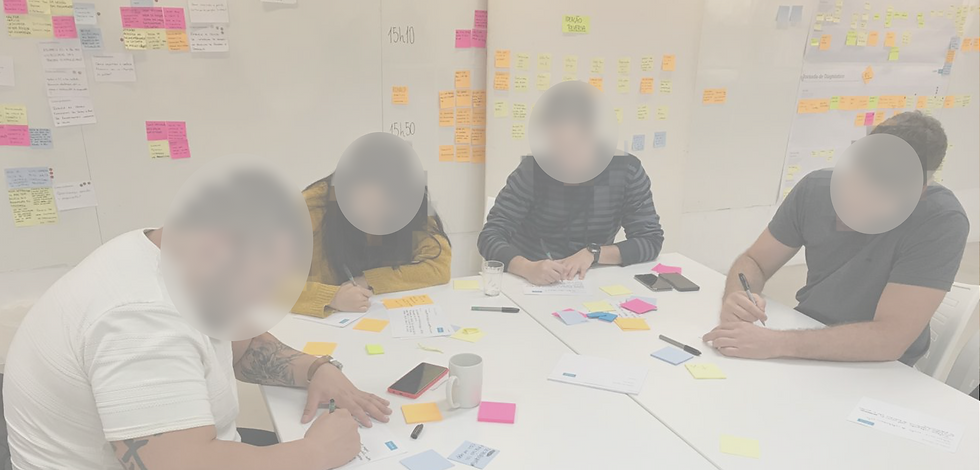
● Facilitating 7 Design Sprints: one for each participant group
● Conducting 2 sessions of User Research for each Design Sprint with external users
. 4 Educational Design Thinking workshops
. 7 Design Sprints: one exclusive week for each employee group selected
. 1 Final Pitch Day, in which the company's leadership team would evaluate the solutions pitch presentation and define the winner
The innovation program was structure with:
Our approach to plan and deliver the innovation program involved the following steps:
Present
● Supporting the groups on developing their solution pitch to present on the Final Pitch Day
My role
Project leader: managing the budget, timelines, project team, and client relations.
As I was leading the project, my main responsibilities involved:
. Project's management: Managing budget, timelines, the project's team and deliverables
. Client's relationship: Being the main contact, managing client's expectations and key alignments with the client along the project
. Design thinking expertise: Developing content for the educational workshops and Design Sprints
. Facilitation: Planning and facilitating 7 different Design Sprints
. Storytelling: Supporting the Design Sprint's participants on developing their solution pitch
. Design research: Mentoring user research recruitment and execution during the Design Sprint's week
Results
. 7 new payment solutions conceptualised, prototyped and tested in the Design Sprint's week
. 7 high-fidelity prototypes + business model proposals of the solutions
. 4 educational Design Thinking workshops
. A personalised service design toolkit to be used by the participants along the program
Adapting the Design Sprint schedule to each project challenge and scope is key.
Food for thought
The main learning when choosing to use the Design Sprint methodology is the need of adapting the Google Ventures original format to each project's goal. We adapted the GV method adding on the first day of sprint an user journey mapping activity and depth interviews with real external users, beyond the validation tests later in the week. These adjustments were fundamental to better understand user's pain points from the start, guiding the ideation session with real user feedback and, consequently, creating relevant solutions to solve their problems.
